
Field Notes - August ‘26 - 41 Pence
From 41p to The Big Issue, and the strange distance between being housed and feeling at home
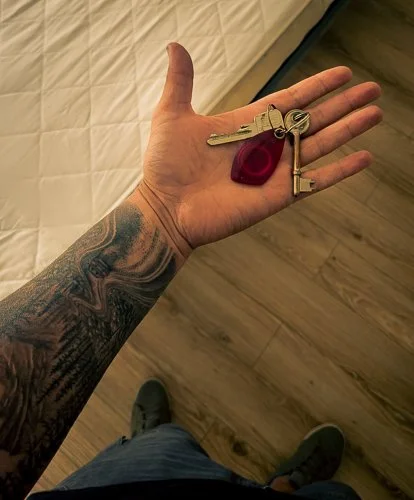
The keys to my new room, August 2026. After 23 nights without a fixed address, I finally had somewhere to go home to.
On the first morning in the new room I woke up before five. There was no tent to pack down, no bedding to hide in the back of the car and no battery percentage to stare at as though it might improve through intimidation. I was simply awake, at an hour my body had apparently decided was now normal.
That was one of the stranger parts of moving indoors. The practical problem had changed overnight, but I hadn't. For weeks I'd carried most of the day around with me: clothes, water, food, chargers, cameras and whatever else I might need before knowing where I'd end up that night. A few days after moving in, I went for a walk without the usual bag and repeatedly checked my pockets because something felt wrong. Nothing was missing. My stuff was just in my room, which for some reason felt suspicious.
Having a room didn't instantly turn into having a finished life either. Most of my belongings were still elsewhere, the main computer was in pieces and the photography archive was spread across drives, a laptop and whatever improvised system had been good enough while I was homeless.
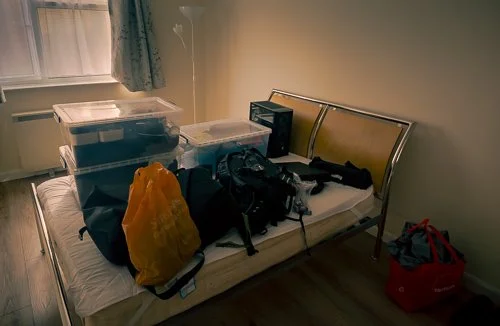
Getting housed was immediate. Getting settled wasn't. My belongings, computer and photography archive slowly made their way back into one place.
Then there was money.
On 10 August I finally recovered the rest of my belongings and returned the old keys. The following morning I had 41p.
That's the sort of detail the inspirational version of rebuilding normally skips. I had a room, I had my things back and I had somewhere safe to sleep, but I also had less money than a supermarket trolley. Being housed and being recovered turned out to be two very different things.
I sold some belongings, found a little breathing room and started buying the boring things that suddenly become important when you're trying to build a home again. Somewhere in the middle of this, the main computer initially refused to rejoin civilisation because I couldn't find a kettle lead. After homelessness, police emails, court forms and moving, the obstacle between me and my proper photography setup was the same cable used by a cheap toaster.
Fortunately the sim rig had one.
Getting the computer running mattered more than it probably should have. Lightroom was there, the drives were there, the scans were there and the normal editing setup was there. For the first time in weeks, photography didn't have to squeeze itself around whatever equipment I could carry in a car or into a tent.
That changed the problem completely.
During July I needed to keep making photographs because I was still trying to understand what No Fixed Address actually was. By August I had hundreds of them, and the question had changed from “what am I photographing?” to “what the hell do I do with all of this?”
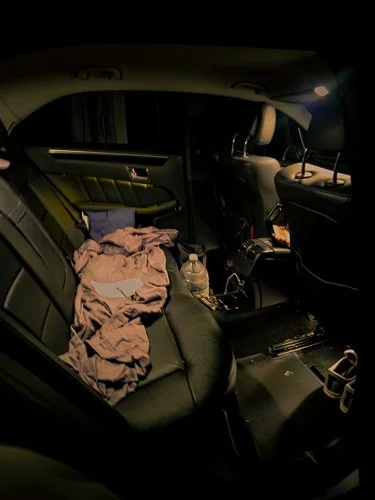
Bedding packed into the back of the car before work. Keeping the bedroom invisible was part of keeping the homelessness invisible.
One editorial package needed six photographs. The website needed a longer sequence. Three went into an exhibition submission. Others needed to stay unpublished because immediately throwing an entire archive onto Instagram is a very efficient way of making it less useful later.
Apparently photography also involves spreadsheets.
Nobody puts that on the camera adverts.
Then 12 August happened.
Exactly one month earlier, on 12 July, I'd made some of the first photographs that became No Fixed Address while sleeping in the car. On 12 August, The Big Issue commissioned me to photograph that experience.
It was the first paid commission to come directly from the project, and I delivered seven photographs with extended captions the following day.
There is something slightly ridiculous about the distance between those two dates. One month I was trying to make a back seat function as a bedroom while continuing to turn up to work as though nothing unusual was happening. The next I was sitting at a desk in a room with a door I could lock, exporting photographs of that bedroom for one of the most recognisable magazines in the country.
Professionally, things were once again going suspiciously well. Everything else remained an admin-based escape room, just with better Wi-Fi.
I also photographed the eclipse because apparently August felt underwritten.
Two days after the commission arrived, I submitted three No Fixed Address photographs to a major London exhibition opportunity: How to Hide a Bedroom, Ramada Laundrette and Work Comes Home. They weren't the prettiest photographs in the archive, which was exactly why I chose them.
A back seat had become a bedroom. A laundrette outside a hotel had become part of staying presentable for work. Boots, trainers and a spanner sat inside a tent because work had followed me home and home happened to be made from canvas. None of those things needed to make homelessness look spectacular. In fact, the more ordinary they looked, the better they explained what I was trying to photograph.
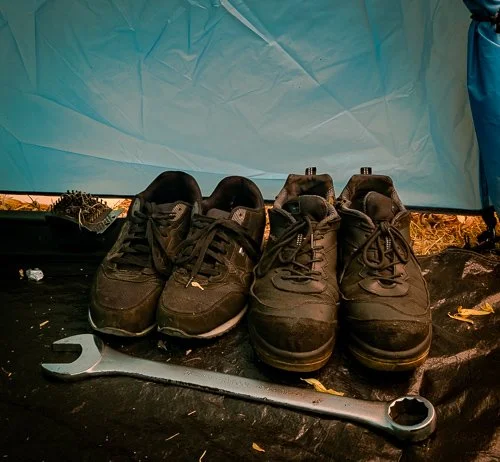
Work boots, trainers and a spanner inside the tent. I was still working full time, even when this was home.
The project itself was becoming much less exciting in the most useful possible way. Instead of constantly making more photographs, I was building press packs, checking dates and locations, sorting captions, tracking rights and preparing another round of approaches.
A surprising amount of trying to become a photographer appears to involve making sure the same picture has the same date in three different documents. I assume Magnum leave that part out of the documentaries.
By this point I'd also become slightly superstitious about announcing anything before I could physically point at it. Emails are real, obviously, but they still exist in a place where somebody else controls what happens next.
Which made 24 August rather useful.
I went out and bought Issue 1732 of The Big Issue.
There it was: Homeless in a Heatwave, across pages 24 to 27, with “PHOTOGRAPHY By SAM SINGLETON” printed above the work.
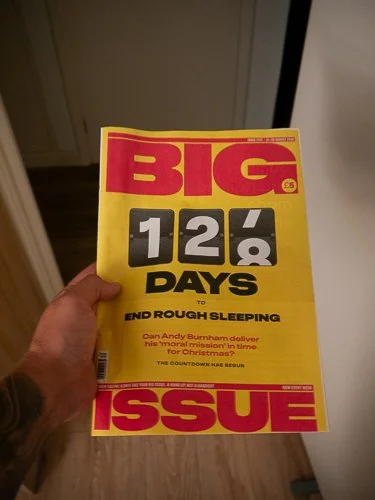
No Fixed Address published in The Big Issue, August 2026. The photographs made while I was homeless became my first paid national publication.
I'm aware that capital letters are not supposed to make something more important, but I'm willing to make an exception.
For nearly two weeks I'd had the commission, the accepted photographs, the correspondence and the invoice, but the magazine was different. I could hold it, open it and turn to the pages. Photographs I had made because my car had become a bedroom were now printed in a national magazine.
My first paid national publication.
I didn't spend very long admiring it before turning the credit into more admin, because I have clearly developed a problem. The next batch of approaches had specifically been waiting for the point where I could truthfully say “Published by The Big Issue” rather than “commissioned by” or “coming soon”, so the moment the magazine existed the next round started moving.
More approaches went out and more conversations started. A documentary photography platform asked to see a larger edit of the work. Other people became interested not only in the photographs themselves, but in what the experience behind them might contribute to wider conversations about homelessness.
That has probably been the most unexpected change during August.
I made No Fixed Address as a photographer trying to document my own circumstances. I wasn't trying to become a spokesperson for homelessness, and I still don't intend to. My experience was relatively short and very specific: I was homeless while still employed full time, and most people around me had no idea.
But that specificity may be exactly what makes the photographs useful.
I still went to work. I still worried about being late. I still changed clothes, washed them, kept cameras with me and tried to make sure nobody noticed that I didn't have somewhere normal to go at the end of the day. The stereotypical image of homelessness is often much more visible than that. If the photographs can make the quieter, hidden version slightly harder to ignore, then the project has a purpose beyond documenting what happened to me.
That has started pushing me into conversations I didn't really expect to be having. There have been discussions about stigma, hidden homelessness and the possibility of speaking publicly about some of this instead of remaining safely behind photographs and captions.
As an introvert, obviously this is excellent news and exactly what I had planned.
At the same time, I've been experimenting with streaming some of the photography work. The rule I've given myself is fairly simple: streaming is allowed to exist only if it supports the photography rather than becoming an elaborate way of avoiding it.
I'm already editing photographs, working in Photoshop, sequencing projects and arguing with myself about crops. Turning a camera on while I do some of that gives people another way into the work. If I eventually find myself spending six hours designing an overlay instead of editing photographs, I will have very clearly misunderstood the assignment.
The first streams have been small, but that's fine. People have wandered in, asked questions and occasionally found the photography afterwards. Talking through an edit is surprisingly useful too, because finished photographs make decisions look far more deliberate than they actually are. In reality there is an enormous amount of moving a crop slightly, deciding the photograph is too warm, changing it, deciding the previous version was better and then pretending the whole process was controlled.
Social media remains a similar balancing act. I want the numbers to grow because a larger audience gives the photography more opportunities to travel, but I don't want to become somebody who spends more time maintaining an account about being a photographer than actually being one.
The more interesting number this month has been nights.
The Big Issue appeared almost exactly when I'd spent as many nights in the new room as I had spent without a fixed address. Nothing magical happened when those numbers met. There was no achievement graphic and the room didn't suddenly become more permanent because a tally said so.
It mattered anyway.
Those homeless nights felt enormous while I was inside them. They already feel much further away than they actually are, but the photographs haven't moved. The back seat bedroom is still a back seat bedroom, the laundrette is still the laundrette and my work boots are still sitting inside the tent.
The thing that has moved is me.
I'm now editing those photographs from a room, writing captions at a desk and sending the work to publications, exhibitions and organisations instead of spending the evening working out where I'm going to sleep.
This weekend gave me perhaps the clearest version of that distance.
I stayed with friends who had helped me while I was homeless. They were the people who washed my clothes when I needed it and gave me somewhere normal to exist for a while. This time I wasn't arriving because I needed anything. I was simply visiting friends.
The following morning they made bacon and egg sandwiches and I drove home.
On the way I stopped to see my sister. We talked about family and everything that's happened, eventually reaching the conclusion that considering where we came from it is mildly surprising that both of us turned out relatively normal.
Normal-ish.
I've thought a lot recently about what family actually means. Some of the people who behaved most like family when everything went wrong weren't necessarily the people connected to me by blood. They were the people who washed clothes, made food, checked in, gave me somewhere to sit and generally continued treating me like the same person when my circumstances had changed completely.
Nobody made one grand gesture that fixed everything. People just showed up.
Then I went home.
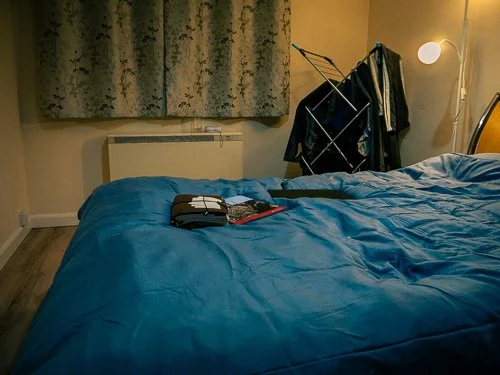
By the end of August, ordinary life had started filling the room. For once, going home didn't require any further explanation.
I spent the evening sitting at my computer working through photographs and metadata while a few small Twitch streams played in the background. Nothing particularly interesting happened, which may actually be the best way this month could have ended.
A few weeks earlier my evenings had revolved around showers, battery percentages, finding somewhere to park and working out how to sleep without drawing attention to myself. Now I was sitting in my own room complaining about metadata while watching somebody with fourteen viewers make a stuffed dinosaur (don’t ask).
Progress comes in strange forms.
No Fixed Address has reached the point where the active shooting can stop. There is still film from that period to work through, hundreds of digital photographs to edit and sequence, and potentially years of printing, pitching, publishing and talking that could grow out of it.
The project isn't finished, but the circumstances are.
I don't need to manufacture an aftermath simply to keep making photographs about homelessness. The archive already exists. The work can keep travelling without me pretending that I'm still living inside it.
And perhaps that is the most useful difference between July and August. When I say I went home now, there isn't really anything else to explain.
Anyway, that's my rambling. If you made it this far, I apologise, and enjoy the rest of your day.
