
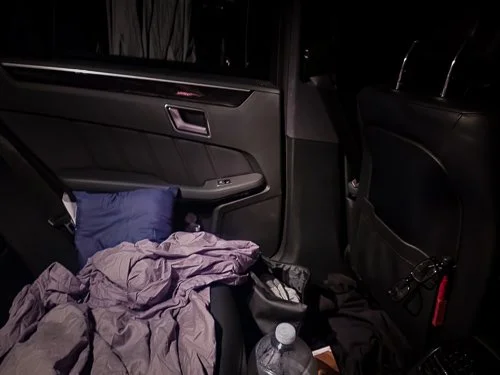
The back seat of my car, which became my bedroom for part of July 2026.
How big should I print them? What do I mount them on? And how the hell do I keep them on a wall?
These are not questions I gave much thought to when I was taking photographs in July. Back then I was more concerned with where I was going to sleep. Now I find myself looking at mounting materials and trying to work out how many pictures can go on a wall without making the whole thing look ridiculous.
A photograph on a screen is easy. It doesn't weigh anything, it doesn't need a frame and you can move it around as many times as you like. An exhibition is rather less forgiving. There are measurements, printing costs, transport and the small matter of getting everything to stay where you put it.
I'm learning.
At the beginning of October, Bristol Central Library agreed to host No Fixed Address for up to four weeks. The project came out of the 23 nights I spent without a home in July, sleeping first in my car and then at a campsite while continuing to work full time as a mechanic. I made the photographs because I wanted a record of what was happening. I certainly wasn't thinking about putting them on a library wall.
So the invitation meant a lot. It was a similar feeling to seeing my photographs published for the first time. I was proud, excited and almost immediately distracted by questions about print sizes.
I went to see the library space on 26 October. It was much bigger than I'd expected. I'd been imagining a few stretches of wall, but there was enough room for people to move through the photographs properly. The dates are pencilled in for 25 January to 21 February. There are plenty of practical things to settle before then, but it feels like a real exhibition now, rather than an idea I've sent off in an email.
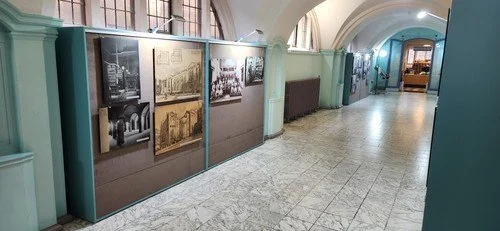
The exhibition space at Bristol Central Library, 26 October 2026. A rather larger wall than I'd expected.
I've been working on the sequence, and the extra space has changed what I can do with it. There are 24 photographs in the current working edit, with questions threaded through them. That doesn't mean all 24 will end up on the wall. I don't want to fill the room simply because I can.
Some of the pictures I've brought back into the edit are very ordinary. Work shoes, kitchens, packing things away. They're the sort of photographs that might get overlooked beside the ones of the car or tent, but they're important to me. The experience wasn't 23 nights of dramatic hardship. Much of it was getting up, finding somewhere to wash, going to work and trying to carry on as normally as possible.
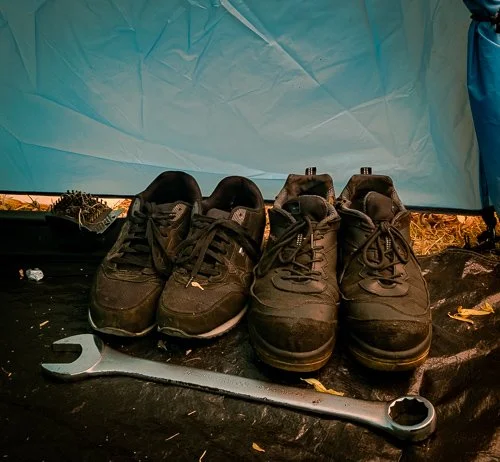
Work boots and trainers outside the tent. Even without a home, there was still work to get up for.
That's one of the things I want people to understand, although I don't want to explain every photograph for them. The questions are there to make people think, not tell them what conclusion to reach. One of the earlier questions needed reworking because it was drifting from what I knew about sleeping in a car and a campsite into what I was implying about official definitions. There is a difference between describing what happened to me and making a wider claim about how a system works. If I'm going to challenge those systems, I'd better get that distinction right.
I have strong opinions about plenty of things, as anyone who's heard me talk about the motor trade will know. But I'd rather give somebody a photograph and a question than stand beside it telling them exactly what they're supposed to feel.
The library hasn't been the only reason I've been thinking about walls. Three photographs were accepted for the Create for People group exhibition, and another three for the People's Art Fair at PRSC. I ordered and framed The Car, The Tent and The Room for the fair, filled out the artwork log and delivered them on 26 October. The show opened on the 30th.
There was something satisfying about handing over three framed photographs. They'd spent so long on my computer that it felt strange to leave them somewhere else. Not send a link or upload a file. Actually carry them through a door and leave them there.
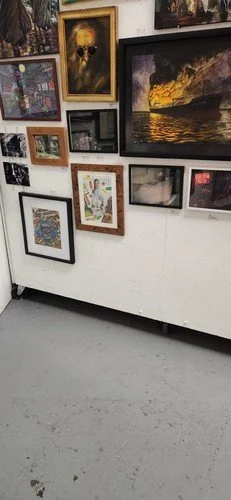
A wall of work at the People's Art Fair, PRSC, Bristol, 1 November 2026.
I volunteered for an invigilation shift too, which means I'll get to see the other side of an exhibition. I imagine there's more to it than looking thoughtfully at photographs and hoping somebody buys one.
The Create for People photographs are different again: How to Hide a Bedroom, Offshift and A Fixed Address. That exhibition is still to come. It's been an unexpectedly busy month for work that began as a very private record of a fairly miserable few weeks.
There was also a set of eight A3 panels to prepare for another event. Photographs, questions, layout, resolution, printing. For several days I seemed to be doing everything associated with photography except taking photographs. I knew what I wanted the panels to say, but making them into something that could stand in a room and be read was another matter.
It's tempting to treat all of this as a sign that things are going brilliantly. Some things genuinely are. The work appeared in NewStart and in print in The Pavement, and a conversation I recorded for The Photowalk came out at the end of the month. I've also been working on the book, which now has a 108-page dummy and a publisher sequence. On 30 October I sent proposals and sample material to three literary agencies.
I don't know whether anything will come of those submissions. The exhibitions are real, though, and so are the publications. A few months ago I was trying to work out whether anybody would be interested in the photographs at all.
The other side of October has been rather less glamorous.
I finished at one garage on 23 October and start at another in November. The new job should put me in a better financial position, which is what I need from it. I haven't suddenly escaped the motor trade. I'm still going to be getting up for work, fixing vehicles and trying to build something outside the workshop in the time I've got left.
And although having somewhere to live again has made an enormous difference, it hasn't magically repaired my finances. There are bills to pay and very little room for anything unexpected. A payment for work published in September spent most of October going through approvals. It arrived on the 28th, but by then I'd already had to borrow money for food and diesel.
The invoice wasn't technically overdue. That doesn't change the fact that there was a stretch of the month when I needed the money and didn't have it. Those are two different things, and I think it's worth saying so.
It's one of the odd things about trying to get this work off the ground. An invitation can be genuinely exciting, somebody can agree to cover the expenses, and you can still be sitting there working out how to afford the journey in the first place. Getting an address back doesn't mean the financial consequences of losing one have gone away.
I've tried to keep making other work in amongst all this. Modern Prophet, a street photograph made in Bristol, went out to a few opportunities, and I started People Watching, a series of short pieces built around my own street photographs. I don't want everything I make from now on to be about homelessness. No Fixed Address matters to me, but I was taking photographs before it happened and I intend to carry on afterwards.
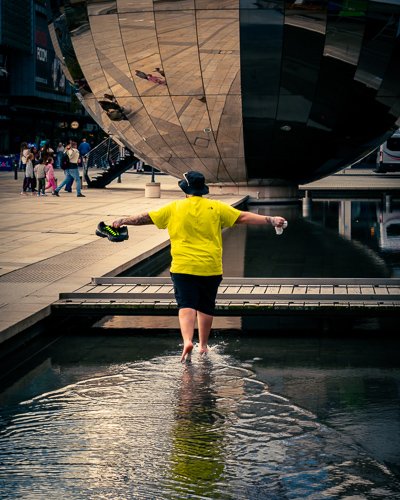
A biblical pose beneath Bristol's mirrored planetarium, caught somewhere between the sacred and the absurd.
Towards the end of the month I got in the car and headed east on the M4. I was watching the fuel gauge rather carefully and feeling ridiculously pleased with the car for managing 61.4 mpg. It was one of those journeys where the difference between a decent and a poor fuel figure actually mattered.
I was going to Westminster for Groundswell's Speak Out event on 29 October.
The eight panels I'd been worrying about were up on the walls at the Abbey Centre, alongside copies of The Pavement carrying the photographs. I saw people stop to read the questions and take photographs of the panels. That was a strange thing to watch. The pictures had started as something I made to keep track of my own circumstances. Now people I didn't know were standing in front of them.
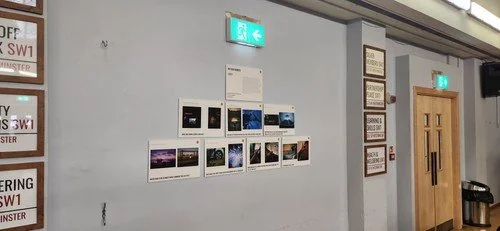
My photographs and questions on display at Groundswell's Speak Out, Westminster, 29 October 2026.
I was there to speak as well. I'd prepared a script about hidden homelessness, going to work while sleeping in a car, and how people can end up falling between different definitions and services. When I stood up, I put the script aside and spoke from what I knew. Then I answered questions.
Once I started talking I didn't need to read anything out. I'd lived it, I'd photographed it and I'd spent months trying to understand the issues around it. I knew what I wanted to say.
Someone afterwards made a point of telling me the photographs were genuinely good. Not just interesting because of the circumstances in which I'd made them. That mattered more than they probably realised. I'm happy for the story to open doors, but I don't want the work to be judged solely on what happened to me.
I drove home having done something I wouldn't have expected of myself a few months ago. I'd stood in front of a room and talked, without a script, about something that mattered to me. And the photographs had been there doing some of the talking too.
I still need to work out the library exhibition, make decisions about the prints and sort through more photographs than I can reasonably put on any wall. There's a book proposal out in the world now, and another month of work to get on with.
I don't know what November will bring. There might be something interesting happening in Northampton, although it's not certain yet. If it does come off, I think it'll be a fun one to tell you about in next month's Field Notes.
But I keep thinking about the people at Speak Out. They didn't know me. They weren't obliged to be interested. They could have walked straight past.
They stopped and looked.
Anyway, that's my rambling. If you made it this far, I apologise, and enjoy the rest of your day.
